Minister of Higher Education Reviews Developments in the Egyptian Genome Project
Dr. Abdelaziz Konsowa Stresses the Importance of Expanding Calls for Applied Research Projects and Building Research Capacity in the Field of Genomics
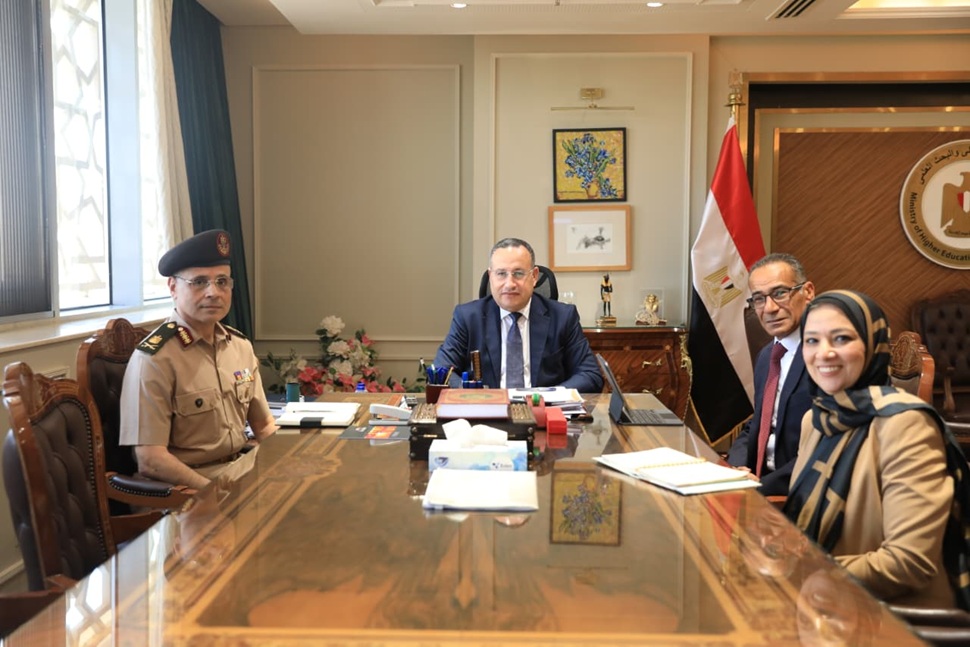
As part of the follow-up on the implementation of the National Egyptian and Ancient Egyptian Reference Genome Project, Dr. Abdelaziz Konsowa, Minister of Higher Education and Scientific Research, chaired a meeting attended by Dr. Gina El-Feky, Acting President of the Academy of Scientific Research and Technology and General Supervisor of the Egyptian Knowledge Bank, Major General Dr. Mostafa El-Naqeeb, Director of the Medical Research and Regenerative Medicine Center at the Ministry of Defense, and Major General Dr. Khaled Amer, Principal Investigator of the Genome Project.
At the beginning of the meeting, Dr. Abdelaziz Konsowa emphasized the significance of the project as one of the largest national scientific research initiatives, highlighting the substantial scientific value it adds and the unprecedented qualitative achievement it represents in Egypt’s scientific research record. He noted the progress achieved in building an accurate reference genetic map that reflects the hereditary characteristics of Egyptians.
The Minister underscored the need to expand the scope of the project through the launch of competitive calls for related research projects in relevant fields, in cooperation with universities and research centers, affirming the Ministry’s readiness to provide the necessary financial support in collaboration with its affiliated research funding bodies.
He also stressed the importance of targeting students, researchers, and faculty members through these calls in order to encourage distinguished talents within universities and research centers in this field, while focusing on practical, applicable projects that address community needs and support national development plans.
The Minister praised the institutional integration among the participating entities, foremost among them the Academy of Scientific Research and Technology and the Medical Research and Regenerative Medicine Center, alongside the relevant ministries, including the Ministries of Health and Population, Tourism and Antiquities, and Youth and Sports. He noted that such cooperation ensures maximizing the benefits of the project’s outcomes and achieving the strategic goals pursued by the الدولة.
Dr. Konsowa also pointed to the project’s international distinction, particularly regarding the study of the genome of ancient Egyptians, noting the ongoing coordination with the relevant authorities to deepen understanding of the genetic evolution of ancient Egyptians through the ages.
The meeting also reviewed the project’s efforts in studying the genomes of gifted and exceptional individuals, given the importance of this work in supporting early discovery mechanisms for extraordinary talents among younger generations and providing appropriate opportunities for their support and development.
For her part, Dr. Gina El-Feky reviewed the latest developments in implementing the project, outlining achievements in full genome sequencing and the establishment of an integrated genetic database, in addition to progress in analyzing genetic variations and linking them to the most common diseases, thereby supporting the state’s move toward precision medicine applications.
The meeting also addressed efforts to build human capacity in genomic sciences by training and qualifying research personnel, including students and researchers, alongside developing an advanced digital infrastructure to support the project.
In addition, several executive aspects were discussed, including strengthening cooperation mechanisms among all participating parties and intensifying communication and coordination to accelerate workflow and ensure integration among the project’s components.
It is worth noting that the Egyptian and Ancient Egyptian Reference Genome Project aims to develop a comprehensive genetic map for the Egyptian population by analyzing thousands of samples representing various governorates and identifying millions of genetic variations. This will contribute to improving the accuracy of diagnosis and treatment, supporting personalized medicine applications, and strengthening Egypt’s regional leadership in genomic research, in line with the state’s vision for localizing biotechnology and achieving sustainable development goals.