▪ Egyptian universities achieved remarkable positions among the world's top 100 institutions in several Sustainable Development Goals (SDGs).
Minister of Higher Education: Egyptian universities are key partners in achieving sustainable development goals and strengthening the knowledge economy.
Times Higher Education (THE) has announced the results of the Impact Rankings 2026, which assess universities based on their contributions to achieving the United Nations Sustainable Development Goals (SDGs).
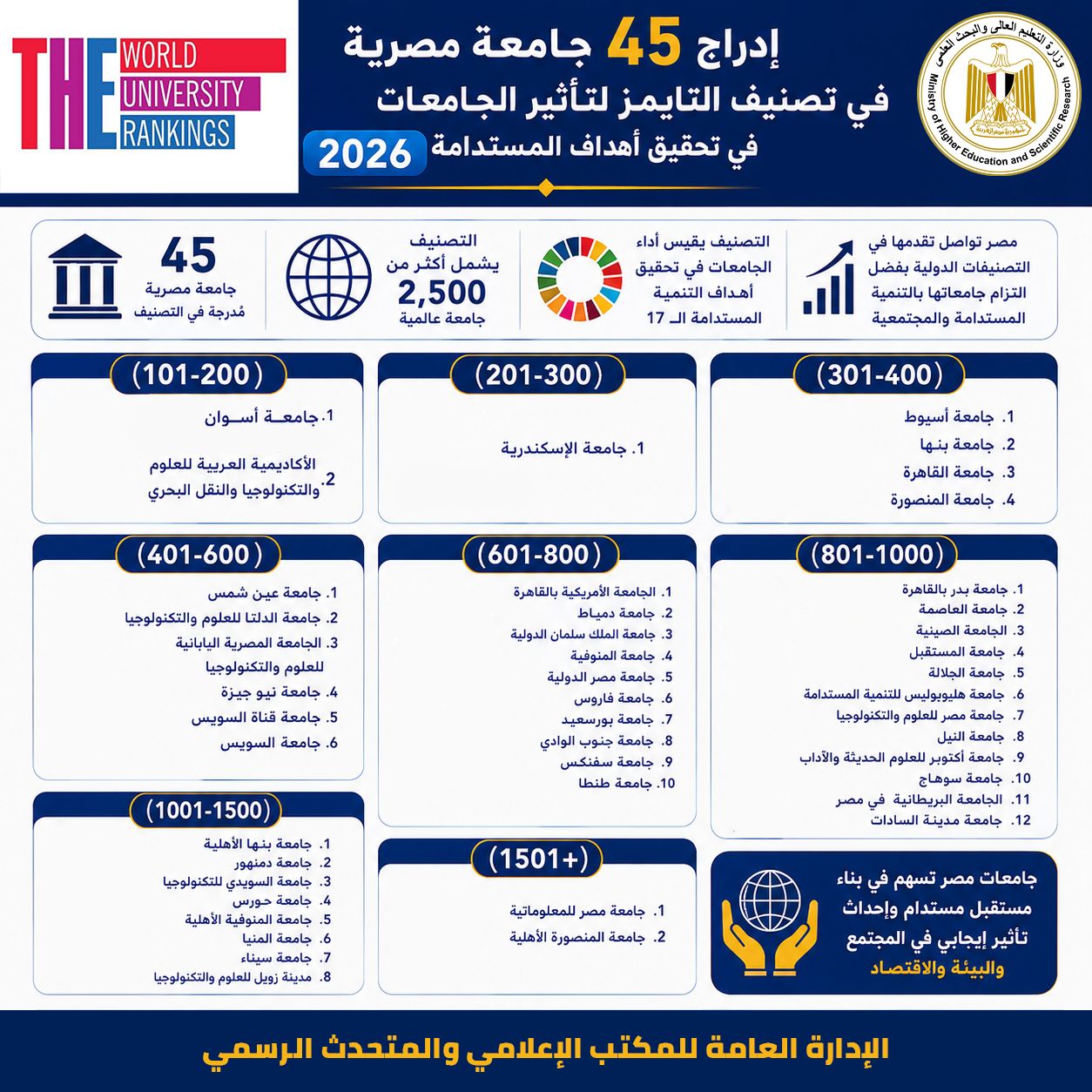
The results revealed that 45 Egyptian universities were included in the 2026 edition of the rankings, reflecting significant progress in the standing of Egyptian universities across various ranking categories.
The rankings placed Aswan University and the Arab Academy for Science, Technology and Maritime Transport (AASTMT) within the 101–200 category globally.
Alexandria University was ranked within the 201–300 category.
Assiut University, Benha University, Cairo University, and Mansoura University were ranked within the 301–400 category.
Within the 401–600 category, the rankings included Ain Shams University, Delta University for Science and Technology, Egypt-Japan University of Science and Technology (E-JUST), New Giza University, Suez Canal University, and Suez University.
The 601–800 category included The American University in Cairo (AUC), Damietta University, King Salman International University, Menoufia University, Misr International University, Pharos University, Port Said University, South Valley University, Sphinx University, and Tanta University.
The 801–1000 category included Badr University in Cairo, Capital University, Chinese University in Egypt, Future University in Egypt, Galala University, Heliopolis University for Sustainable Development, Misr University for Science and Technology, Nile University, October University for Modern Sciences and Arts (MSA), Sohag University, The British University in Egypt, and Sadat City University.
Within the 1001–1500 category were Benha National University, Damanhour University, Elsewedy University of Technology, Horus University, Menoufia National University, Minia University, Sinai University, and Zewail City of Science, Technology and Innovation.
Meanwhile, Misr University for Informatics and Mansoura National University were ranked in the 1501+ category.
As part of the assessment across the 17 Sustainable Development Goals, Egyptian universities achieved distinguished international recognition, securing top-100 global positions in a number of SDG indicators.
Key achievements include:
-
No Poverty: Cairo University (48th globally), AASTMT (63rd globally).
-
Zero Hunger: Cairo University (84th globally), Aswan University (95th globally).
-
Good Health and Well-being: New Giza University (92nd globally).
-
Quality Education: AASTMT (18th globally).
-
Clean Water and Sanitation: Alexandria University (16th globally), AASTMT (97th globally).
-
Affordable and Clean Energy: Alexandria University (8th globally), AASTMT (19th globally), Assiut University (54th globally), Aswan University (92nd globally).
-
Decent Work and Economic Growth: AASTMT (24th globally), Assiut University (60th globally).
-
Industry, Innovation and Infrastructure: Mansoura University (39th globally).
-
Reduced Inequalities: AASTMT (96th globally).
-
Sustainable Cities and Communities: Aswan University (43rd globally).
-
Responsible Consumption and Production: Ain Shams University (28th globally), Sphinx University (58th globally), AASTMT (91st globally).
-
Climate Action: Alexandria University (93rd globally).
-
Life Below Water: Suez University (41st globally), Assiut University (98th globally).
-
Life on Land: AASTMT (66th globally).
-
Peace, Justice and Strong Institutions: AASTMT (44th globally).
-
Partnerships for the Goals: Aswan University (14th globally).
Dr. Abdelaziz Konsowa, Minister of Higher Education and Scientific Research, stated that the progress achieved by Egyptian universities in the Times Higher Education Impact Rankings 2026 reflects the commitment of higher education institutions to supporting sustainable development goals through enhancing the quality of education and scientific research, expanding community and international partnerships, adopting sustainability-oriented institutional practices, and contributing to the development of a knowledge-based economy.
The Minister noted that the Ministry places great emphasis on integrating sustainable development principles into educational, research, and community service activities, thereby supporting the objectives of Egypt Vision 2030 and strengthening the global standing of Egyptian universities.
Dr. Adel Abdel Ghaffar, Media Advisor and Official Spokesperson for the Ministry, affirmed the Ministry’s continued efforts to enhance the competitiveness of Egyptian universities and reinforce Egypt’s position as a distinguished regional hub for higher education and scientific research. These efforts include advancing the national research ecosystem, expanding international research collaboration, and promoting high-quality joint research with strong citation impact, thereby increasing publication opportunities in high-impact scientific journals.
The spokesperson also highlighted the outstanding efforts of Egyptian universities in pursuing academic and research excellence, which are reflected in their continuous progress across prestigious international rankings.
The THE Sustainability Impact Rankings 2026, published by Times Higher Education, are recognized as the only global rankings that comprehensively measure universities’ contributions to achieving the 17 United Nations Sustainable Development Goals.
The 2026 edition evaluated 1,646 universities from 116 countries and territories. The ranking methodology is based on four key dimensions: research, stewardship and governance of resources, outreach and partnerships, and teaching. Universities are assessed through a combination of quantitative and qualitative indicators linked to each Sustainable Development Goal and overall ranking performance.
These indicators include the volume and impact of scientific research, institutional policies and initiatives, community engagement programs, and sustainability-related educational activities.
It is also worth noting the significant role played by the Egyptian Knowledge Bank (EKB) in providing extensive scientific resources to Egyptian researchers and scholars. This has contributed to strengthening scientific research in Egypt, enhancing the global visibility of research institutions, and improving the international rankings of Egyptian universities, research institutions, and scientific centers. These achievements have also been supported by the dedicated efforts of university ranking committees in monitoring and meeting the evolving requirements of international ranking systems.