High-Level Participation Marks the Opening of the First International Islamic Forum on Islamic Civilization
The Center for Islamic Civilization in Uzbekistan: A Platform for Knowledge and Innovation
Initiatives to Strengthen Research Cooperation and Harness Artificial Intelligence for the Preservation of Heritage
A Call for a Lasting Alliance to Advance Knowledge Production and Shape the Future
Dr. Abdelaziz Konsowa, Minister of Higher Education and Scientific Research and President of the General Conference of the Islamic World Educational, Scientific and Cultural Organization (ICESCO), participated in the opening day of the First International Islamic Forum on Islamic Civilization, held under the theme "A Path to Peace, Tolerance, and Enlightenment," from July 7 to 11, 2026, in the Uzbek cities of Tashkent, Samarkand, and Termez.
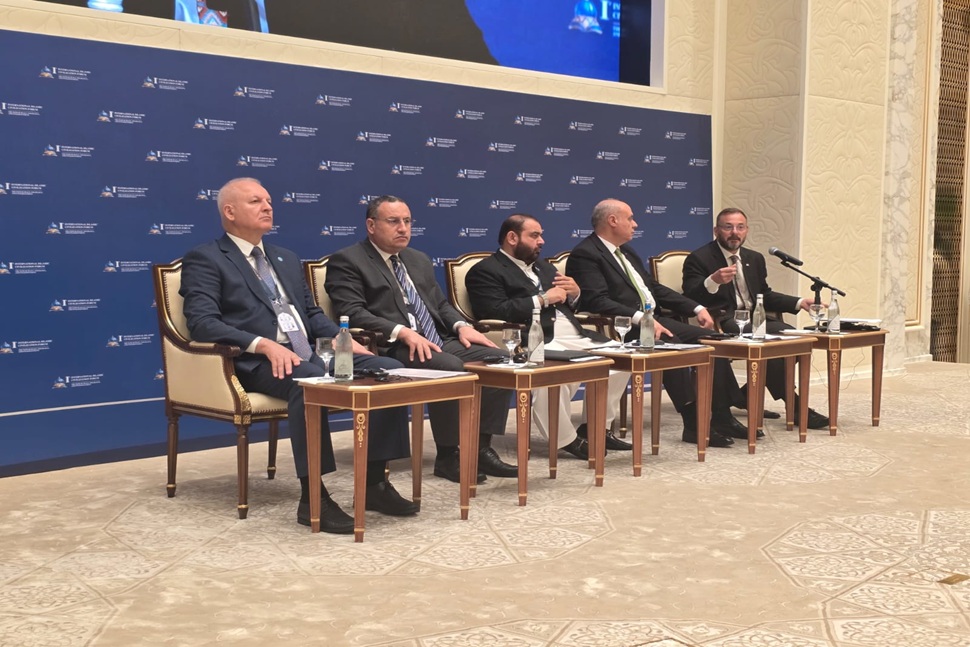
The opening session brought together the Minister of Higher Education and Scientific Research alongside ministers, representatives of member states, Grand Muftis, scholars, intellectuals, and experts participating in the forum.
Dr. Konsowa also delivered a keynote address during the forum's third plenary session, titled "The Center for Islamic Civilization in Uzbekistan: An International Platform for Innovative Research and Educational Initiatives." The session was attended by H.E. Ozodbek Nazarbekov, Minister of Culture of the Republic of Uzbekistan; H.E. Dr. Salim M. AlMalik, Director-General of ICESCO; as well as ministers, representatives of member states, Grand Muftis, and distinguished scholars.
At the outset of his remarks, Dr. Konsowa noted that he was participating in his capacity as Egypt's Minister of Higher Education and Scientific Research and President of the ICESCO General Conference. He emphasized the importance of the session's theme, highlighting the pivotal role of the Center for Islamic Civilization in Uzbekistan as an international platform for innovative research and educational initiatives.
The Minister extended his sincere congratulations and appreciation to the Republic of Uzbekistan, under the leadership of H.E. President Shavkat Mirziyoyev, for this exceptional civilizational project, describing it as a forward-looking initiative that transforms Islamic heritage into a driving force for cultural, educational, and scientific development rather than merely preserving it as a record of the past.
Reflecting on his visit to the Center for Islamic Civilization, Dr. Konsowa praised its integrated vision, which combines the authenticity of Islamic civilization with state-of-the-art museum practices, scientific documentation, and advanced digital technologies. He noted that the Center does not merely preserve history but reinterprets it for future generations in the language of the modern age, making heritage a source of inspiration, knowledge, and innovation.
He stressed that the Center is far more than a museum dedicated to Islamic civilization; it serves as a global platform for intercultural dialogue, a hub for knowledge production, and an incubator for research and educational initiatives, reflecting the historical mission of Islamic civilization, which has always been founded on knowledge, openness, creativity, and respect for human diversity.
The Minister observed that the fundamental question before the session is not simply how to preserve heritage, but how to transform heritage into the future. Nations that lead the future, he noted, are not only those with great histories, but those capable of transforming history into knowledge, knowledge into innovation, and innovation into economic and societal value.
He emphasized that throughout history, Islamic civilization has been a civilization of knowledge creation rather than mere knowledge preservation. Its schools, universities, libraries, and observatories generated intellectual contributions that laid the foundations for humanity's progress in medicine, engineering, mathematics, astronomy, philosophy, and the humanities.
Dr. Konsowa underlined that today's responsibility is to reinvest this rich civilizational legacy in building more innovative educational systems, more impactful scientific research, and more competitive knowledge-based economies.
He pointed out that the Center for Islamic Civilization in Uzbekistan possesses all the necessary capabilities to lead a new phase of cooperation among Islamic countries by establishing a specialized research network on the history of Islamic science and civilization; launching a unified digital manuscript platform powered by artificial intelligence for cataloguing, translation, and analysis; developing joint academic programs in digital heritage and digital humanities; supporting collaborative research grants; and creating cultural innovation laboratories that connect researchers with developers and entrepreneurs to transform heritage into innovative educational, cultural, and tourism applications.
In this context, the Minister stressed that artificial intelligence should not be limited to digitizing heritage. Rather, it should contribute to building trusted Arab and Islamic knowledge bases, developing language models that accurately reflect the region's civilization, and strengthening the Islamic world's presence in the global digital revolution, ensuring that it contributes to producing digital knowledge rather than merely consuming it.
Dr. Konsowa also reviewed Egypt's experience in building a new generation of leading universities that combine academic excellence, impactful scientific research, innovation, entrepreneurship, expanded international partnerships, the integration of artificial intelligence into education and research, and stronger links between applied research, industry, and sustainable development, positioning universities as key drivers of the knowledge economy.
He affirmed that cooperation with the Center for Islamic Civilization in Uzbekistan could open new opportunities for joint research projects, dual-degree programs, academic training, researcher exchange, digital knowledge production, and capacity building in digital heritage, innovation, and artificial intelligence.
Building on this vision, the Minister proposed launching the "Islamic Platform for Future Sciences, Fatwa, and Artificial Intelligence" as a joint initiative between ICESCO and the Center for Islamic Civilization in Uzbekistan. The platform would operate under the supervision of a scientific council comprising Grand Muftis, scholars, ministers of higher education and scientific research, and experts in artificial intelligence, data science, digital ethics, social sciences, and futures studies.
He explained that the platform would establish a shared scientific reference framework to address emerging issues arising from the digital revolution through a forward-looking approach that combines sound Islamic jurisprudence, rigorous scientific understanding, and strategic foresight. This would support collective scholarly reasoning capable of responding to rapid developments in artificial intelligence, digital medicine, robotics, big data, digital currencies, and other emerging technologies.
The proposed platform would also develop a unified knowledge base for fatwas and scholarly studies, produce policy papers and ethical guidelines, and launch specialized training programs and professional certificates aimed at preparing a new generation of scholars and researchers equipped with expertise in Islamic jurisprudence, technology, and AI ethics.
The Minister emphasized that the essence of this initiative is not merely to answer the question, "What is the ruling on using technology?" Rather, it seeks to address a more profound question: How can the Islamic world contribute to guiding technology in ways that serve humanity, preserve human dignity, promote justice, strengthen knowledge, and advance civilization?
He added that this approach shifts fatwa from a reactive process to one based on foresight and guidance, transforming Islamic scholarly reasoning into a knowledge-driven force capable of shaping the future of artificial intelligence while remaining firmly grounded in the objectives of Islamic law and open to the advances of modern science.
Concluding his address, Dr. Konsowa stressed that preserving heritage today extends far beyond safeguarding monuments and manuscripts. It means transforming heritage into knowledge, knowledge into innovation, and innovation into sustainable development, thereby strengthening the position of the Islamic world within the global knowledge economy.
He further noted that Egypt's presidency of the ICESCO General Conference represents a responsibility the country is proud to undertake and motivates it to support initiatives that deepen cooperation among member states in higher education, scientific research, culture, and innovation while building new bridges between identity and openness, authenticity and progress.
The Minister called for the establishment of a permanent alliance bringing together ICESCO, the Center for Islamic Civilization in Uzbekistan, leading universities, fatwa institutions, and research centers to serve as a global platform for knowledge production, scientific research, digital content development, and the application of artificial intelligence in the service of heritage, civilization, and humanity.
He concluded by affirming that Islamic civilization has never been a civilization of boundaries, but rather a civilization of bridges connecting nations and cultures, science and faith, and the past with the future. Today's responsibility, he said, is to build the next bridge—one that connects a rich civilizational heritage with the revolution in artificial intelligence and future sciences—so that the Islamic world continues to contribute to shaping the future, just as it has long contributed to the advancement of human civilization.