Dr. Abdelaziz Konsowa, Minister of Higher Education and Scientific Research, accompanied by Dr. El-Sayed Kandil, President of Capital University, inaugurated and inspected a number of major development projects at the University on Sunday, in the presence of university leaders and public figures.
The Minister began his tour by inspecting the renovation works at the Student Hospital adjacent to the Faculty of Engineering. The hospital building has been designated for conversion into a teaching hospital that will provide both healthcare services and clinical training for the University's medical faculties.
Dr. Konsowa then reviewed the construction progress of the University's Medical Complex, including the Outpatient Clinics Building, which constitutes the first phase of one of the largest medical and educational projects at Egyptian universities. The complex will have a total capacity of 1,600 beds and will be equipped with state-of-the-art medical technologies. It is expected to serve more than eight million citizens through an integrated healthcare system that includes outpatient clinics, emergency services, operating theatres, intensive care units, oncology and radiotherapy services, dialysis units, central laboratories, as well as education and training centers.
The tour also included the inauguration of the Faculty of Engineering Development Project, which features the modernization of the faculty's building façades in line with the University's new visual identity, landscaping and campus improvements, renovation of sports facilities, and upgrading lecture halls, classrooms, and laboratories with the latest presentation and communication technologies to enhance the quality of education and scientific research. The Minister also toured the University's Nanotechnology Research Center, which is equipped with advanced research instruments and cutting-edge technologies.
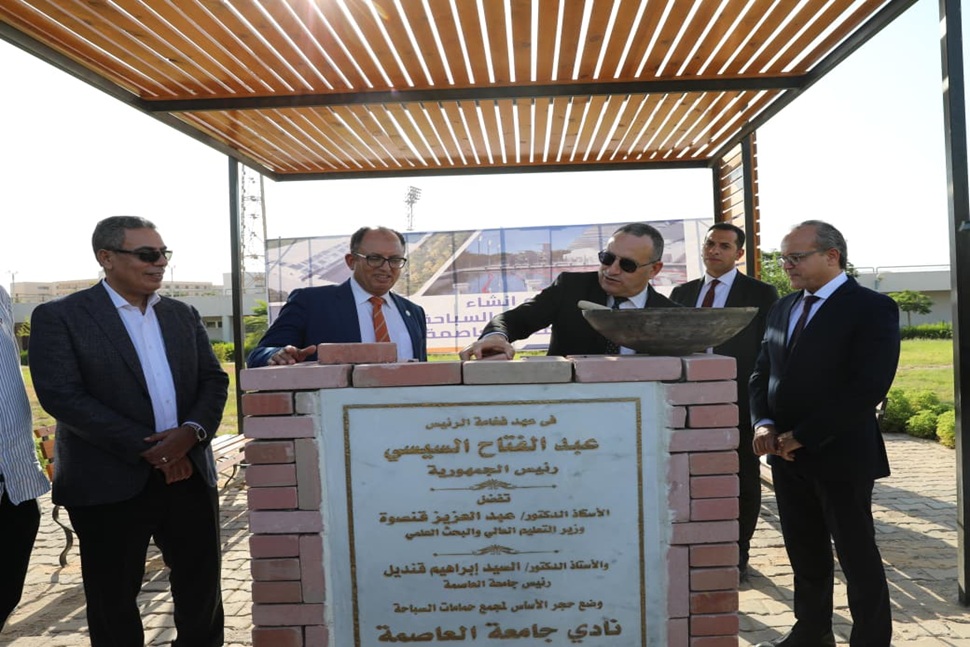
The Minister also inaugurated the newly rebranded Capital University Club, officially announcing its new name following its renaming from Helwan University Club. Five new sports facilities were also inaugurated, including two padel courts and three squash courts. In addition, the foundation stone was laid for a new 7,000-square-meter Aquatic Sports Complex, which will feature an Olympic-sized 50-meter swimming pool, a 25-meter training pool, and a dedicated aqua park.
The visit further included the inauguration of the Late Muneera Al-Nayef Mosque, which was constructed through funding provided by the Kuwaiti Office for Charitable Projects. The Minister also unveiled the University's new logo and foundation stone reflecting its new name, and inaugurated the Central Operations Room at the University's Administrative Building.
The smart operations center operates through an integrated security system supported by 125 surveillance cameras. The first phase of the project also included the installation of 519 surveillance cameras inside and around several university buildings, including the Faculties of Pharmacy, Art Education, Music Education, Fine Arts, Commerce and Business Administration, Tourism and Hotels, as well as the Central Laboratory and the Information and Communication Technology Center.
Dr. Konsowa also inaugurated the upgraded Central Computer Laboratory, which houses approximately 500 computers. The Smart Training Center has likewise been renovated and equipped with 169 computer workstations, supported by upgraded digital infrastructure and a new central server room. The facility also includes a comprehensive security system comprising 23 surveillance cameras, an early fire detection system, modern interactive displays, audiovisual systems, and air-conditioning, creating a smart learning and training environment that supports digital transformation while enhancing the efficiency of training programs and electronic examinations.
The University also launched its new digital innovation and entrepreneurship platform, "Talaqi", which aims to establish a comprehensive digital ecosystem connecting researchers, students, faculty members, entrepreneurs, companies, and industrial institutions. The platform is designed to transform research outcomes and innovative ideas into market-ready projects and products. It includes around 30 specialized tracks, enabling companies to present their industrial challenges and investment opportunities while allowing researchers to showcase applied research and innovation projects. The platform is expected to promote technology transfer and localization, strengthen university-industry collaboration, and support the knowledge economy and entrepreneurship.
Dr. Abdelaziz Konsowa commended Capital University for continuing to implement its comprehensive strategy to develop its academic, research, and service infrastructure, reflecting its commitment to enhancing the quality of higher education and improving the educational and research environment. He noted that the University's distinguished academic staff and advanced research capabilities constitute a fundamental pillar for achieving academic excellence, fostering innovation, strengthening community engagement, and supporting national development priorities.
The Minister added that these development projects form part of the state's broader strategy to modernize Egyptian universities and expand their capacities in line with the objectives of the New Republic. He emphasized that upgrading university facilities and infrastructure contributes to improving the efficiency of higher education institutions, strengthening their competitiveness at both the national and international levels, and preparing highly qualified graduates capable of contributing to sustainable development and supporting a knowledge-based economy.
For his part, Dr. El-Sayed Kandil affirmed that Capital University continues to implement an ambitious strategy to develop its educational, medical, and sports facilities, based on its commitment to student well-being and improving quality of life across the campus. He noted that these projects are part of the University's ongoing efforts to provide a modern educational and research environment that aligns with international standards while supporting educational quality, innovation, and scientific research.